
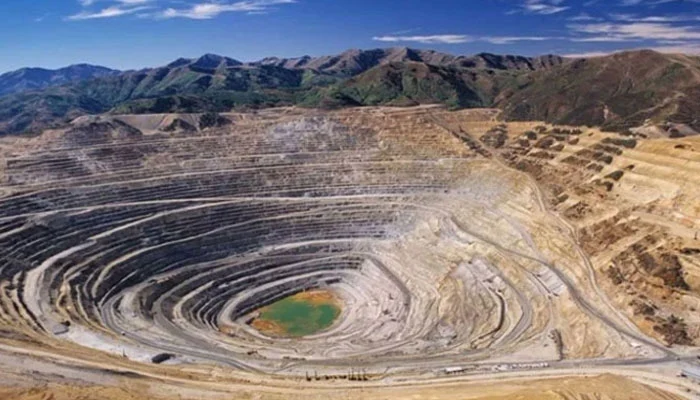
Reko Diq minerals’ transportation: ML-3 track upgrade to cost Rs278.6bn
ISLAMABAD: In a bid to ensure smooth transportation of minerals products from multibillion-dollar Reko Diq mines, government is moving towards upgrading rail track and allied infrastructure on Main Line (ML-3) from Rohri-Sibi-Quetta-Koh-e-Taftan section.
The 996km project carries an estimated cost of Rs278.618 billion and is expected to be completed by 2033.
According to project documents, the scheme will be financed through bridge financing provided by Reko Diq Mining Company (RDMC), along with funding from Government of Pakistan through Public Sector Development Programme (PSDP).
Official documents and the project’s PC-I state the bridge financing will be repaid by Government of Pakistan through a lump-sum (bullet) payment by June 2028, requiring Ministry of Finance to arrange necessary funds.
The project will be implemented in two phases comprising four packages. Under Phase I, Package 1 covers upgrade of 243km Rohri-Sibi section, while Package 2 involves 522km Spezand-Alam Reg section. Phase II includes 14km Sibi–Quetta section and 90km Alam Reg-Taftan section.
According to PC-I, upgrading ML-3 railway line is the only sustainable solution for transporting mineral products from Reko Diq mines, for which Government of Pakistan has already signed an agreement with Barrick Gold/RDMC.
The upgraded railway line is expected to significantly improve safety and service quality by reducing derailments, shortening transportation time, and increasing fuel efficiency.
The project includes upgrade of ML-3 track from Rohri to Koh-e-Taftan. It involves complete renewal of 195km of track on Rohri-Sibi section and 636km on Quetta-Spezand-Koh-e-Taftan section, including reconstruction of 457.5km Ahmedwal-Koh-e-Taftan stretch through construction of properly engineered embankments and bridges.
Additionally, 11 new railway stations will be built between Spezand and Alam Reg to improve train operations.
The project has been divided into two phases. Phase I will focus on critical infrastructure upgrades, while Phase II will cover priority-II works. The cost of security to be provided by Frontier Corps (FC) has also been included in PC-I.
The project’s primary objectives include complete renewal of railway track from Quetta to Taftan, construction of new stations in areas with long block sections, and installation of efficient communication system.
In its appraisal, Planning Commission stated the project would substantially reduce derailment-related losses. It also noted removal of engineering restrictions would shorten transportation times. The Commission observed the project would provide safer and more reliable railway infrastructure, improve train speeds, and enhance line capacity. However, it pointed out the project sponsors had neither quantified the expected economic benefits nor conducted a comprehensive cost-benefit analysis.
As a result, financial viability of the proposed investment cannot be fully assessed. The Commission noted the total project cost of Rs278.618 billion, including escalation and security expenses, is substantial and requires stronger justification through quantified freight traffic and revenue projections.
The appraisal highlighted that no clear tariff structure, Track Access Charges framework, or revenue-sharing arrangement with RDMC has been specified.
Furthermore, project’s long-term sustainability depends on adequate operation and maintenance (O&M) funding after completion, but current project documents allocate zero funding for post-completion O&M.
The security cost, estimated at Rs46.38 billion, accounts for approximately 17 percent of total project cost. The Planning Commission observed this could affect project’s overall financial viability and suggested exploring a cost-sharing arrangement with provincial government.
The appraisal further noted no post-completion operating costs have been included, potentially understating the project’s lifecycle costs and distorting its financial sustainability assessment.
It warned $390 million bridge financing provided by RDMC, which must be repaid by Government of Pakistan through a bullet payment by June 2028, creates significant fiscal pressure and repayment risks for federal government.
The Commission cautioned heavy dependence on a single major client — Reko Diq mining project — creates concentration risk for projected freight revenues. It observed 6.5 percent escalation provision may prove insufficient given the project’s 7-year implementation period and its reliance on imported materials such as rails and fastening systems.