
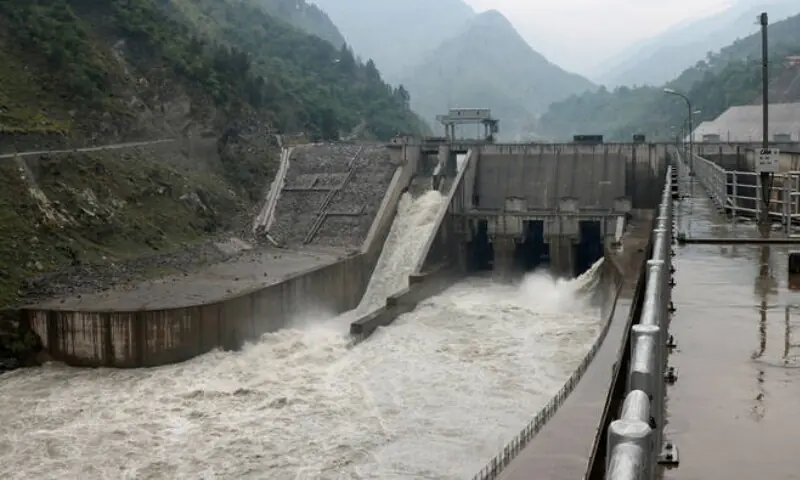
Government moves to create Wapda security force for major water projects
ISLAMABAD: The federal government has decided to establish a dedicated Wapda Security Force to protect major water infrastructure projects across the country and the people working on them, particularly Chinese engineers and workers. The proposed force is being created through the Wapda Security Force Act, 2026, which has already been sent to parliament for approval.
According to the statement of objects and reasons attached to the draft law, the new force is intended to safeguard critical infrastructure managed by the Water and Power Development Authority.
“The Wapda Security Force is being constituted to ensure the protection and security of critical infrastructure managed by the Water and Power Development Authority,” it states.
The move comes after two terrorist attacks on personnel linked to the more than $6 billion Dasu Hydropower Project in November 2021 and March 2024, in which Chinese and Pakistani workers were among those killed. An official said the decision to create a separate force followed those attacks and formed part of a broader overhaul of Wapda’s security arrangements.
The official said two special security divisions of the Pakistan Army, one for the north and one for the south, had been protecting China-Pakistan Economic Corridor projects in Balochistan and along the route up to Gilgit-Baltistan. Still, Wapda projects were not covered under that arrangement. He said a separate mechanism was therefore required.
He also recalled that after the attack on the Dasu project staff and the resulting loss of life, the Chinese side suspended work on the project for more than a year. The project resumed later after engagement at the highest government level and the payment of compensation, despite delays and higher costs.
A CPEC-style security arrangement was later extended to other projects involving Chinese workers through an outer security layer provided by the Pakistan Army, in addition to Wapda’s internal security, local police, and Rangers or the Frontier Constabulary in other provinces. Following consultations with the Chinese side, the prime minister directed that projects involving Chinese nationals, as well as other nationally important water-sector schemes, should receive CPEC-level security cover.
The Wapda Security Force will be headed by a director general, most likely drawn from the armed forces. It will have its own uniform, insignia and official stamp, and will operate in notified areas across Pakistan with a defined mandate to protect water-sector projects.
Its responsibilities will include the protection of dams, power plants, installations, machinery, equipment, offices, personnel and official residences. It will also be tasked with preventing offences related to these assets. The force is expected to provide security for the K-4 Greater Water Supply Scheme in Sindh alongside Rangers and local police, while in Khyber Pakhtunkhwa and Balochistan, it will work with Frontier Constabulary personnel.
Under the draft law, the federal government will exercise superintendence over the force, while operational control will remain with Wapda. The force will be responsible for ensuring adequate security in notified areas and for protecting Wapda employees and others working on Wapda projects, including during travel to and from those areas, through coordination with law enforcement and intelligence agencies.
The proposed law also allows the force to coordinate with and assist other law enforcement and intelligence bodies, if directed by the government, in protecting notified areas from encroachment and trespassing after notification in the official gazette. Its strength will be determined according to security needs from time to time.
The draft legislation says officers and staff of the Wapda Security Force will fall under the Essential Services Act and will not be permitted to take up any other employment while serving in the force. It also says the Industrial Relations Act, 2012, and the Industrial and Commercial Employment (Standing Orders) Ordinance, 1968, will not apply to any officer or staff member of the force.
The proposed law further provides legal indemnity to the government, Wapda, the director general, officers and staff of the force, and any other person exercising powers or performing functions under the law in good faith.
“In particular and without prejudice to the generality of the provisions of the act, an officer or staff of the force shall not be subject to any criminal or civil liability for actions taken in exercise of powers and functions under this Wapda Security Force Act,” it states.