
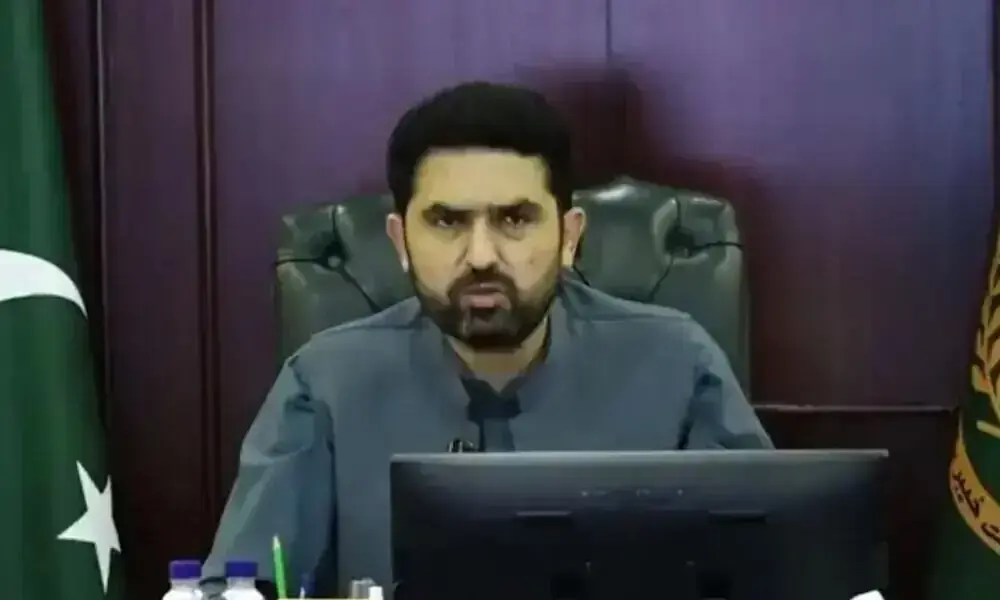
CM Afridi launches work on underpass in Peshawar
PESHAWAR: Khyber Pakhtunkhwa Chief Minister Sohail Afridi on Thursday performed groundbreaking for the Jameel Chowk Underpass here under the Peshawar Revitalisation Plan.
Addressing the groundbreaking ceremony, the chief minister said that work on various projects initiated under the Peshawar Revitalisation Plan was progressing rapidly and that the progress of projects launched earlier was visible.
He said the provincial government had committed to completing those projects within the stipulated period and the projects had either been completed or had reached the final stages of completion.
“The Jameel Chowk Underpass has now also been launched, with a stipulated completion period of 90 days. However, the provincial government will complete the project well ahead of its completion time,” he said.
Mr Afridi said around Rs200 billion worth of development projects were being undertaken in Peshawar under the Peshawar Revitalisation Plan.
He said public resentment towards state institutions had increased during this period.
The chief minister said Pakistan was heading towards serious decline and if those making decisions for Pakistan, who were holding state institutions, parliament and democracy hostage, did not reconsider their approach, the situation would deteriorate further.
He said Pakistan was being harmed by misguided policies and decisions taken behind closed doors, adding that such policies were weakening the foundations of the country.
Mr Afridi expressed serious concern over the prevailing law and order situation in Khyber Pakhtunkhwa, observing that as a consequence of misguided policies, police personnel were becoming increasingly defiant. He questioned the policy framework under which the police were being called upon to sacrifice their lives.
The chief minister said essentially the same security policy had been pursued in Khyber Pakhtunkhwa for the past 22 years, yet it had failed to deliver the desired results.
He said the province had witnessed 22 major operations, approximately 14,000 intelligence-based operations and several other major operations.
Mr Afridi said despite those efforts, insecurity persisted and terrorism continued to increase.
Turning to the judiciary, he said political workers had remained subjected to prolonged difficulties and that judges had also become constrained in the exercise of their authority.
The chief minister said three Supreme Court judges had directed that Imran Khan be provided medical treatment at Shifa International Hospital but the direction had not been implemented.
He stressed that the issue was not about the strength or weakness of Imran Khan or Pakistan Tehreek-i-Insaf but about the institutional authority and independence of the judiciary.
Mr Afridi called upon judges across the country to reflect on the implications for the judiciary when its decisions are not implemented, saying that failure to enforce judicial orders undermines the authority and dignity of the institution itself.
He warned that when people were denied access to judicial justice, frustration and anger would inevitably grow.
“If citizens are ultimately compelled to seek justice themselves, the consequences could be extremely serious.”
The chief minister said anger and resentment among young people towards state institutions were increasing and that the situation had reached a critical point.
He said if the country’s youth, economically and socially disadvantaged segments and the middle class took to the streets, the resulting situation would be extremely difficult to control.
Mr Afridi said the frustration and anger accumulating among the people would inevitably find an outlet.
He said the removal of Imran Khan’s government had adversely affected Pakistan’s economic progress, contributed to growing public resentment towards state institutions and intensified the difficulties faced by ordinary citizens.
The chief minister said that Pakistan Tehreek-e-Insaf would hold a protest in Islamabad on September 27, in which a large number of workers and citizens will participate.