
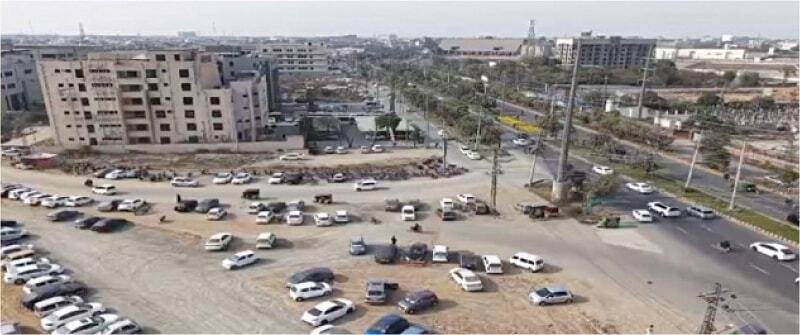
LDA wants uniform commercialisation on Pine Avenue
LAHORE: The Lahore Development Authority (LDA) is working on a proposal to introduce a uniform commercialisation on the Pine Avenue — the Lahore Metropolitan City’s new and growing corridor nearing completion, and execution of a number of commercial projects in both public and private sectors.
The proposal, if approved by the authority, will provide the LDA with huge revenue amounting to Rs134 billion in commercialisation fee in the next five years, Dawn has learnt through reliable sources.
On the other hand, the length of Pine Avenue has been proposed to be increased by 25 kilometers with the addition of a stretch of an under-construction structure plan road starting from Ayub Chowk in Johar Town and ending at the Qadir Tobash Chowk.
“We want to control the unplanned and illegal commercialisation on the Pine Avenue corridor by all means keeping in view its strategic importance in terms of connectivity from all sides. The growing population, development of huge infrastructure, especially the country’s largest cancer hospital by the Punjab government and several other projects by the private sector, the increasing footfall and hundreds of thousands of vehicles pass through it everyday are also a factor,” a senior officials of the LDA’s town planning wing explained while talking to Dawn on Sunday.
“Moreover, the Pine Avenue is also a prime route being used on a daily basis by the chief minister, who also wants a uniform commercialisation on this road as well other major thoroughfares in the city,” the official requesting anonymity added.
According to a proposal recently shared with the LDA’s top authorities, commercial activity had been recommended to be approved only for those having plots with 200 feet depth starting from the Pine Avenue. To start a commercial project, the sponsors/owners will have to leave a 40-feet setback area from the front for parking, adequate pedestrian movement, visual uniformity and other permissible use under the law. The height of the building will be allowed to be 200 feet (ground and another 14 storeys) with unformed facade designs as approved by the LDA.
The proposal points out that an area on the Pine Avenue that had already been commercialised under the annual development plan and commercialisation entitlements for those who had surrendered their land for the structure plan roads consisting of nearly 279 kanals. However, the area comprising 89,455 marlas was yet to be commercialised. Besides this, the 8.7km area on its roads, passing through private housing societies, was also to be commercialised.
It reveals that the calculation of per marla commercialisation cost had been estimated as Rs15 million with the total revenue amounting to Rs134 billion. The Rs134 billion revenue was expected to be collected in five years starting from year-1 with Rs40.2 billion and Rs26.8 billion, Rs22.78 billion, Rs22.78 billion and Rs21.44 billion in year two, three, four and five respectively.
The proposal further revealed that the total length of the Pine Avenue, which was initially 4.5 kilometer from Valencia Chowk to the Ring Road via Shanu Baba Chowk and DHA Phase-11 and was later increased to 15km with the addition of Qadir Tobash Chowk to Valencia intersection and Ring Road to Ferozepur Road via Lake City, Neelum Road. Various housing schemes and LDA City has now taken it to a total of 25km with the addition of the stretch starting from the Ayub Chowk to Qadir Tobash Chowk via Abdul Sattar Edhi Road.
“We want that the government should first benefit from the commercialisation as a top priority and earn revenue instead of giving it to private housing schemes, which want commercialisation rights of their plots facing the structure plan roads passing through their land or the landowners surrendering their land for such roads,” the official maintained. He said the proposal also recommends acquiring land required for structure plan roads through the existing provisions of the Land Acquisition Act, 1894, undertake detailed classification, reclassification and redevelopment studies of the newly-developed corridors in consultation with relevant agencies such as Tepa, Wasa, and EPA. Moreover, the plan would ensure implementing development control regulations to ensure orderly urban form, controlled access, parking standards, and mixed-use compatibility, he added.