
Pakistan’s $8 Trillion Question — Who’s Going to Drill It?
Every few years, a number comes along that reframes how a country sees itself. For Pakistan right now, that number is $8 trillion — the estimated value of our mineral reserves, spread across copper, gold, chromite, lithium, rare earths and more, over roughly 600,000 square kilometres.
It’s a staggering figure. And next month, the world’s investors, miners and policymakers will gather in Islamabad to talk about it. The Pakistan Minerals Investment Forum (PMIF26) — 12–13 November at the Jinnah Convention Centre — is where Pakistan makes its case: grow mineral exports from around $3 billion today to a target of $8 billion, and turn a sector that currently contributes under 3% of GDP into one of the engines of the next decade.
At SKY Air Compressors, we’re proud to support PMIF26. But I want to make an argument that usually gets lost in the excitement of forums like this.
A reserve in the ground is not revenue. It’s a promise. And the distance between the two is measured in drilled metres, broken rock and moved tonnes.
The slide nobody puts in the investment deck
Investment forums are built around capital, policy and geology — and rightly so. You can’t mine without a license, a feasibility study and someone willing to write a very large cheque. Reko Diq alone carries a capital investment estimated at nearly $9 billion and a mine life measured in decades.
But somewhere between the signed MoU and the first export shipment is a layer of work that no keynote ever covers: the unglamorous, relentless, physical business of getting ore out of the earth.
That work runs on a surprisingly humble machine — the air compressor.
Walk any serious mine, quarry or exploration site and you’ll find compressed air doing the heavy lifting:
- Drilling — pneumatic and down-the-hole (DTH) hammers punch the blast holes. High-pressure air is literally what breaks the first ground.
- Breaking and demolition — jackhammers and breakers at the face, on rock that excavators can’t touch.
- Dewatering, sandblasting, and cleaning — the daily maintenance of keeping a site productive.
Most of it happens where there is no grid, no shade and no margin for downtime. A mine in Chagai or a quarry in the northern belt doesn’t have a power line waiting at the pit edge. The energy has to arrive on wheels, in the form of a diesel-driven portable compressor that can survive dust, heat and the back of a truck on a bad road.
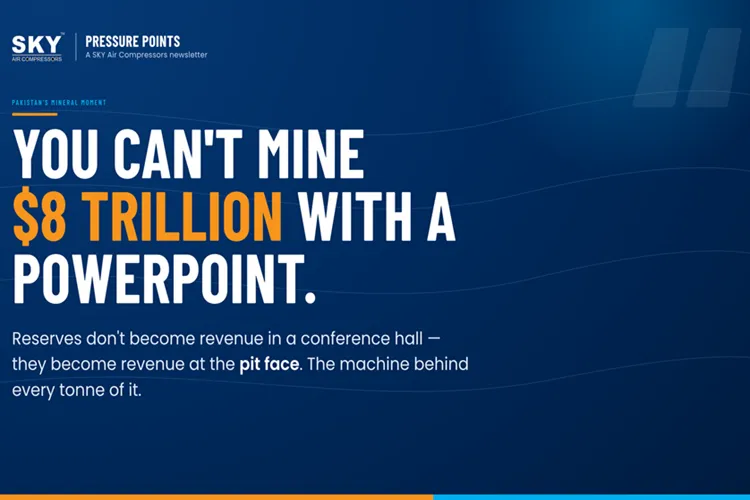
Scale the mining sector, and this entire layer has to scale with it. You cannot drill a $8 trillion opportunity with a PowerPoint.
The Pakistan factor
Here’s something I wish more equipment buyers thought about before they sign a purchase order: most compressed-air equipment in the world is specified for 38°C ambient temperature.
Pakistan laughs at 38°C. Our mining and construction belts routinely push past 45°C in summer, with coastal humidity in the south and fine, abrasive dust almost everywhere. Equipment specified for a cooler climate quietly derates, overheats and fails early — usually at the worst possible moment, mid-shift, with a drilling crew standing idle.
The lesson we’ve learned supplying into Pakistani sites is simple: the spec sheet is not the story. The operating environment is. A machine built and supported for local conditions — with parts and service close by — is worth far more than a slightly cheaper one that spends August in a workshop.
What support actually looks like
Supporting Pakistan’s mineral moment isn’t only about applauding the investment numbers. For an equipment company, it means being genuinely useful to the operators who’ll do the work:
- Spec the right compressor for the job — not the biggest one on the shelf, the correct one for the drilling pressure, air demand and site conditions. (A quick note for honesty’s sake: our portable CY range spans roughly 3.5–34 m³/min and 7–30 bar across different models — no single machine does all of it, and anyone who tells you otherwise is selling, not engineering.)
- Build and support equipment for 45°C-plus, dust and vibration, not a lab bench.
- Keep aftermarket parts and service within reach, because uptime is the only metric that matters at the face.
- Do it at a price that lets a Pakistani operator compete. Our whole reason for existing is that line: German quality — at half the price. Why pay more?
We’re already putting this into practice. A SKY portable compressor is in service today at one of Pakistan’s largest copper-gold developments in Balochistan — in exactly the no-grid, high-heat, high-dust conditions this equipment is built for. Not on a stage. On a site.
The real question
So as Pakistan heads into PMIF26, I’d gently reframe the headline. The question isn’t only how much is Pakistan’s mineral wealth worth? It’s who is going to do the physical work of extracting it — and with what?
The reserves are real. The investment is arriving. The decade ahead will be built, quite literally, one drilled metre at a time. The companies that win won’t just be the ones with the biggest balance sheets — they’ll be the ones whose equipment shows up and keeps running.
That’s the part SKY is here for. And it’s why we’re proud to stand behind PMIF26.
If you’re attending PMIF26 as a mining operator, EPC contractor, driller or quarry operator, I’d genuinely like to connect — drop a comment or message. And if you want more plain-spoken takes on the machines and infrastructure behind Pakistan’s industrial growth, subscribe to Pressure Points.
SKY Air Compressors · skyair-compressors.com · +92 334 593 3391 · info@skyair-compressors.com
#PMIF26 #Mining #Pakistan #CriticalMinerals #CompressedAir #SKYAirCompressors